
XT30 and XT30U connectors look almost identical, which makes the choice confusing when you are selecting connectors for a drone, RC aircraft, LiPo battery, ESC, charger, or compact power system. Both belong to the small XT-series power connector family, but the XT30U is the newer, more compact design and has become the more practical choice for many new projects.
The important point is that XT30 vs XT30U is not simply a question of which connector carries more current. Wire size, continuous load, connector temperature, installation space, mating frequency, and the physical design of the finished harness all matter. Understanding these differences before purchasing can prevent unnecessary replacement work later.
XT30 vs XT30U: The Basic Difference
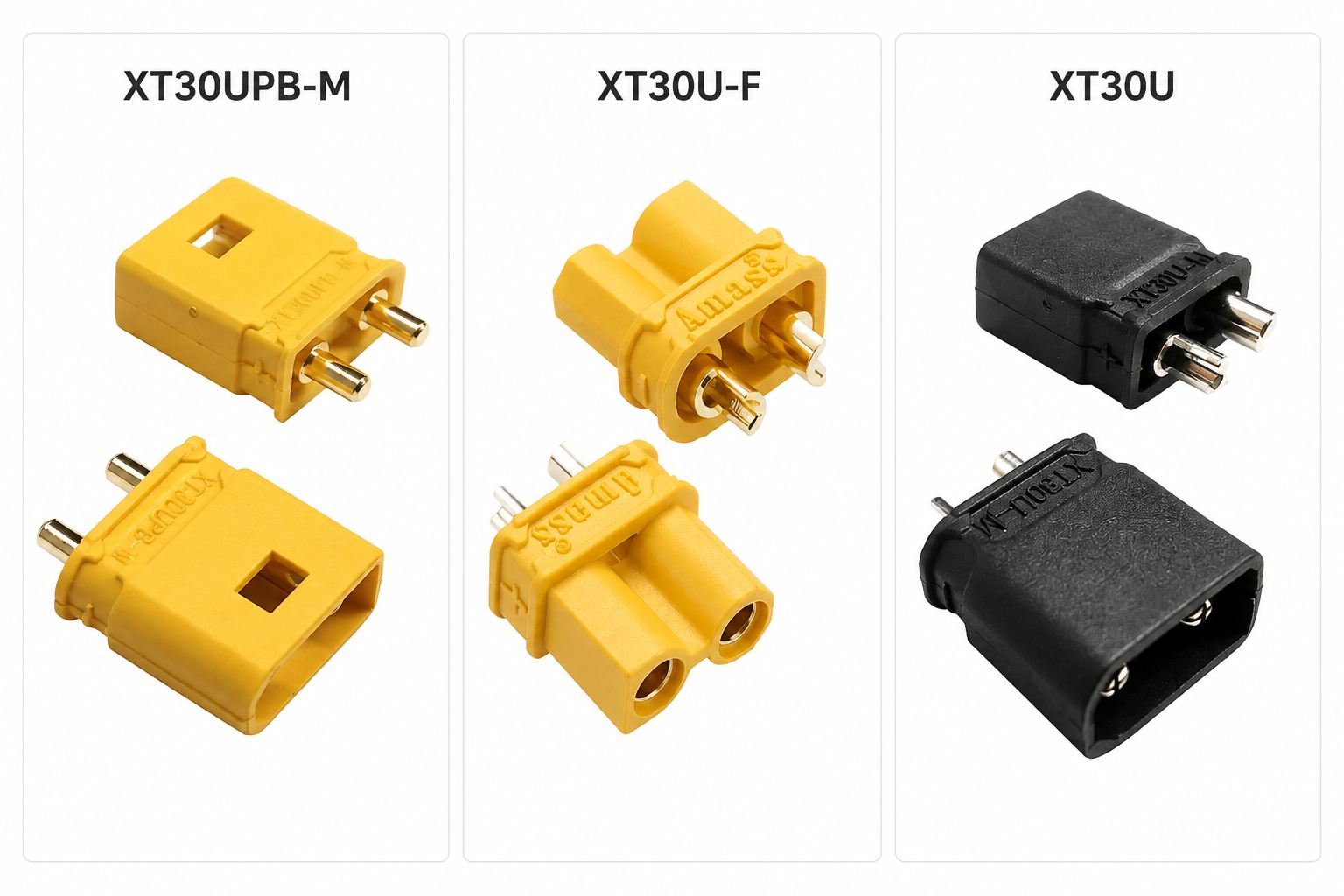
The original XT30 was designed as a compact two-pin DC power connector for small battery-powered equipment. XT30U retains the same basic two-pole power connection concept but uses a more compact housing design. In current product catalogs, XT30U is widely positioned as the standard compact cable connector for applications such as batteries, controllers, drones, and small electric systems.
For a new design, XT30U is generally the easier version to specify because it offers a compact package without requiring a major change in the electrical concept of an XT30 connection. However, engineers should still check the exact model number rather than assuming every XT30-family connector has identical specifications.
| Feature | XT30 | XT30U |
|---|---|---|
| Connector type | 2-pin DC power connector | 2-pin DC power connector |
| Main application | Small battery-powered equipment | Drones, RC models, batteries, controllers and compact power systems |
| Current class | Small high-current DC applications | Up to 20 A max under specified catalog conditions |
| Temperature range | Typically around -20°C to 120°C, depending on exact model | -20°C to 120°C for current XT30U specifications |
| Mechanical life | Typically specified around 100 mating cycles | 100 mating cycles in current specifications |
| Design priority | Established compact connector design | More compact and modernized housing design |
The exact rating should always be checked against the connector's part number, wire gauge and installation conditions. For example, current AMASS XT30U specifications list 20 A maximum with 16 AWG under a specified temperature-rise condition, while other commercial listings may quote lower continuous ratings depending on their test method and application. A connector's advertised "30" should therefore not be treated as a universal continuous-current rating.
Why Was XT30U Developed?
The main advantage of XT30U is packaging efficiency. In drones and RC equipment, every millimeter and every gram can matter. A connector that performs the required electrical function while taking up less space is easier to integrate into a compact battery compartment or wiring harness.
This becomes particularly important when the connector is installed close to an ESC, flight controller, battery pack, or enclosure wall. A bulky connector can force the cable to bend sharply, increase strain on solder joints, or make assembly more difficult.
For this reason, an XT30U Battery Connector for Drones is often a better fit for compact UAV and FPV designs where connector size and cable routing are important.
Current Rating: The Number on the Connector Is Not Enough
One of the most common mistakes is choosing a connector solely because its series name contains a current-related number. The real thermal limit depends on contact resistance, conductor size, current duration, ambient temperature, airflow and the number of connectors operating inside the same enclosure.
A useful way to evaluate the connector is to consider the relationship between current and heat generation. Electrical losses in the contact are approximately proportional to:
P = I²R
This means that doubling current does not simply double connector heating. If current rises from 10 A to 20 A while contact resistance remains unchanged, resistive heating increases by approximately four times.
| Current | Relative I² Heating | Design Implication |
|---|---|---|
| 5 A | 1× | Low connector heating |
| 10 A | 4× | Thermal performance becomes more relevant |
| 15 A | 9× | Check wire gauge and connector temperature |
| 20 A | 16× | Requires careful thermal and wiring design |
This is why a connector that works perfectly at 8–10 A may become noticeably warmer when operated continuously near its upper rating. For battery systems, engineers should distinguish between short-duration peak current and continuous current.
XT30U and Wire Gauge Selection
The connector and cable should be treated as one electrical assembly. Installing a high-current connector onto an undersized wire does not create a high-current harness.
Current XT30U documentation specifies 20 A maximum under a stated 16 AWG test condition. The practical choice can still vary depending on cable length, insulation temperature rating, installation method and duty cycle.
| Wire Size | Typical Use | What to Check |
|---|---|---|
| 18 AWG | Small drones and compact electronics | Continuous current and cable length |
| 16 AWG | Higher-current compact battery systems | Connector temperature and duty cycle |
| 14 AWG | Applications requiring heavier conductors | Physical solder-cup space and connector compatibility |
For pre-assembled products, an XT30U Connector with Silicone Wire can reduce assembly time because the connector and cable are supplied as a prepared unit. This is useful for battery packs, controller assemblies and production harnesses where repeatable wire length and solder quality are important.
XT30 vs XT30U for Drone and RC Applications
Drones are one of the clearest examples of why the XT30U design is attractive. A typical small UAV power path may contain a battery connector, ESC wiring, power distribution section and several signal cables. The power connector needs to carry the required current without adding unnecessary size or weight.
XT30U is particularly suitable when the design needs a compact two-pin connector and the operating current falls within the connector's verified rating. It is also useful when the battery or ESC needs to be disconnected regularly during maintenance.
| Application | Recommended Approach | Reason |
|---|---|---|
| FPV drone | XT30U | Compact size and suitable current range |
| Small RC aircraft | XT30U | Low weight and easy battery connection |
| Small LiPo battery | XT30U | Compact battery-side connection |
| Higher-current power system | Consider larger XT series | More thermal and current headroom may be required |
| PCB-mounted power input | XT30UPB or suitable PCB version | Designed for board-level installation |
Do XT30 and XT30U Fit Each Other?
Compatibility is one of the areas where buyers should pay attention to the exact connector version. XT-series products are available in different mechanical configurations, including cable, PCB, right-angle and other variants. Two products can share the XT30 family name without having the same physical installation method.
If replacing an existing connector, compare the male/female configuration, housing geometry, cable exit direction, mounting method and exact part number. Do not purchase based only on the "XT30" name.
For a new design, selecting the XT30U family from the beginning is usually simpler than designing around an older connector and changing it later. For an existing production line, however, the cost of changing tooling, cable lengths, crimp or solder processes and inventory should also be considered.
XT30U Male and Female Options
The XT30U family is available in male and female versions, as well as different mounting and cable configurations. A standard cable assembly normally consists of a male connector on one side and a female connector on the mating side.
For battery applications, an XT30U Male Female Battery Plugs set can be used to create detachable connections between a battery pack and an ESC, controller, charger or other DC load. When specifying the assembly, buyers should confirm connector gender, wire gauge, wire length, insulation material and polarity before production.
When Should You Choose XT30 Instead?
There are still situations where retaining an existing XT30 design makes more sense than changing to XT30U. If an established product already uses XT30 connectors, the electrical design has passed testing, and the connector is readily available, replacing it simply because XT30U is newer may offer little practical benefit.
XT30 can also remain appropriate when the existing mechanical layout, housing cutout, cable routing and assembly tooling were designed specifically around the original connector.
The decision is different for a new product. If the electrical requirements are similar and the mechanical design benefits from a smaller connector, XT30U is generally the more attractive starting point.
A Practical Selection Checklist
| Question | Why It Matters |
|---|---|
| What is the continuous current? | Determines whether the connector has sufficient thermal capacity. |
| What is the peak current? | Short bursts can behave differently from continuous loads. |
| What wire gauge is required? | The connector rating and cable capacity must work together. |
| How much installation space is available? | A compact connector can simplify cable routing. |
| How frequently will it be disconnected? | Mechanical life becomes important in serviceable equipment. |
| Is it cable-mounted or PCB-mounted? | Different XT30-family variants are designed for different installation methods. |
| Is this a new design or replacement? | Existing tooling and mechanical compatibility can outweigh the benefits of switching. |
Which One Should You Choose?
For a new compact battery-powered product, XT30U is usually the better starting point when its current and voltage specifications meet the system requirements. Its compact housing makes it well suited to drones, RC aircraft, LiPo batteries, ESCs and other applications where space and weight are limited.
For an existing product, there is no automatic need to replace XT30 with XT30U. Keep the original connector if it already meets the electrical, mechanical and production requirements. The upgrade becomes more worthwhile when the project needs a smaller connector, a revised harness layout, or a new connector family for future production.
Most importantly, choose by the complete electrical and mechanical specification rather than the connector name alone. Check continuous current, peak current, wire gauge, contact resistance, operating temperature, mating life, mounting configuration and the exact manufacturer part number before placing a bulk order.


 IPv6 network supported