

Battery Energy Storage Systems (BESS) are becoming a critical component in modern energy infrastructure, supporting renewable energy integration, grid stabilization, industrial backup power, and commercial energy management. As battery capacities increase from hundreds of kilowatt-hours to multi-megawatt systems, electrical safety, power efficiency, and system reliability have become major concerns.
One often overlooked component that directly affects BESS performance is the wiring system. A properly designed Battery Energy Storage System Wiring Harness ensures stable power transmission, accurate monitoring, thermal management, and protection against electrical failures. Unlike ordinary cables, BESS wiring solutions are engineered to handle high current loads, harsh environments, and long-term operational demands.
This article explains how advanced wiring harness solutions improve BESS safety and efficiency, what design factors engineers should consider, and why high-quality cable assemblies are essential for next-generation energy storage applications.
A BESS contains multiple battery modules, battery racks, power conversion systems (PCS), battery management systems (BMS), and monitoring equipment. All these components require reliable electrical connections to operate safely.
The wiring harness acts as the electrical connection network between individual battery cells, modules, and external power systems. It is responsible for transferring high electrical currents while maintaining signal accuracy and preventing potential hazards such as overheating, short circuits, and connection failures.
| Component | Function | Wiring Requirement |
|---|---|---|
| Battery Modules | Store and deliver electrical energy | High-current connection with low resistance |
| Battery Management System (BMS) | Monitors voltage, temperature, and battery status | Reliable signal and communication wiring |
| Power Conversion System (PCS) | Converts DC power to AC power | High voltage and high current cable assemblies |
| Thermal Management System | Controls battery temperature | Durable wiring suitable for heat and vibration |
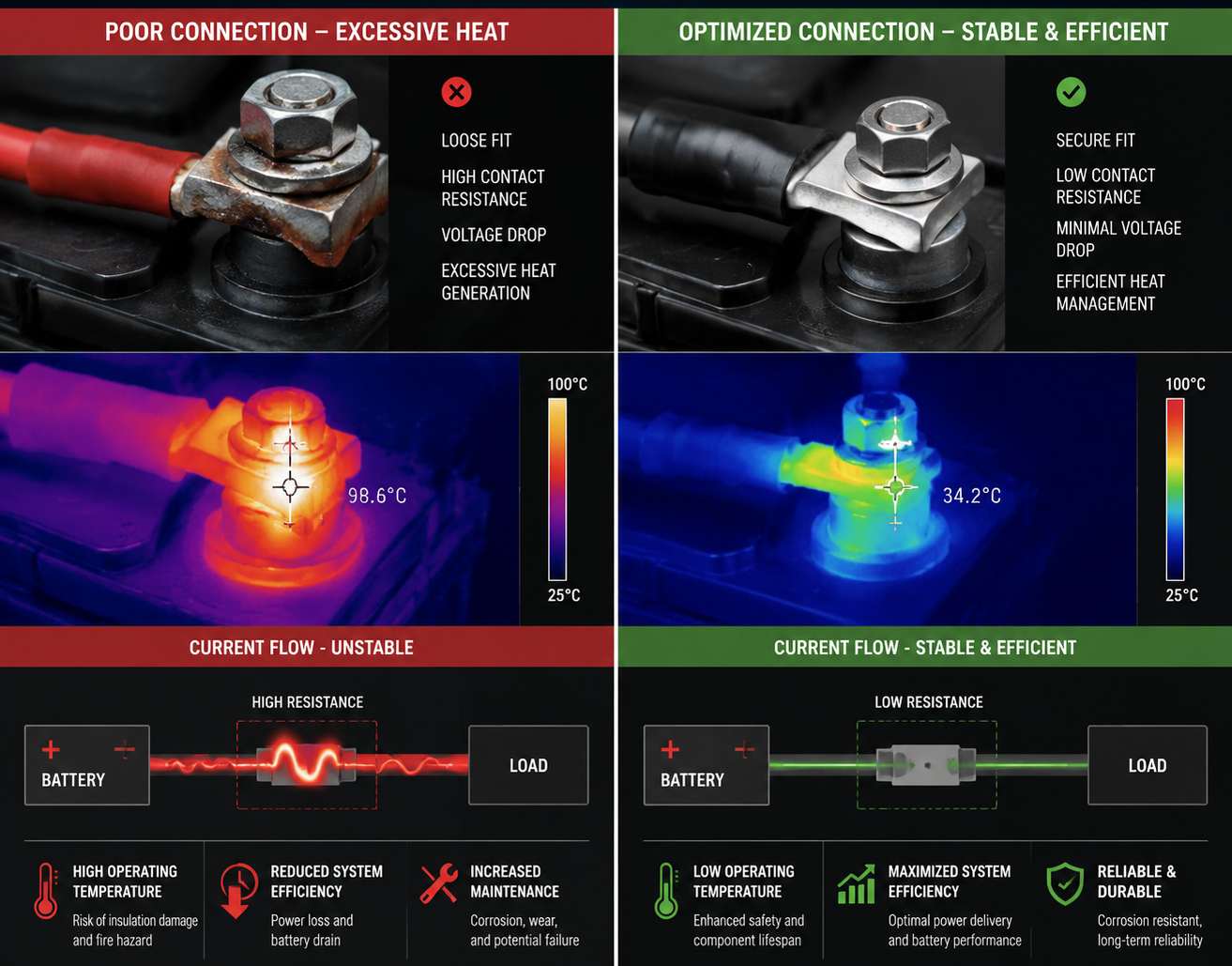
Electrical safety is one of the biggest challenges in large-scale energy storage systems. Loose connections, poor insulation, or incorrect cable selection can create excessive resistance, resulting in heat generation and potential thermal events.
A professionally designed BESS Wiring Harness improves safety by using optimized conductor sizes, high-temperature insulation materials, secure terminals, and protective structures. These designs reduce electrical losses and maintain stable performance even under continuous high-current operation.
| Safety Factor | Potential Risk | Wiring Harness Solution |
|---|---|---|
| Connection Reliability | Loose terminals causing heat buildup | Precision crimping and locking connectors |
| Insulation Protection | Short circuits or electrical leakage | Flame-resistant and high-voltage insulation materials |
| Current Handling | Cable overheating under high loads | Optimized conductor diameter and thermal design |
| Environmental Protection | Moisture, dust, and corrosion damage | Protective sleeves and sealing solutions |
Energy efficiency is a key performance indicator for BESS projects. Even small electrical losses can significantly impact operating costs in large-scale storage systems running continuously for years.
High-quality wiring harnesses minimize energy loss by reducing resistance and improving current flow stability. For example, a poorly designed connection with increased resistance can generate additional heat and waste energy, while optimized cable assemblies maintain efficient power transmission.
| Parameter | Standard Cable Design | Optimized BESS Cable Solution |
|---|---|---|
| Electrical Resistance | Higher energy loss | Lower resistance for improved efficiency |
| Heat Generation | More thermal stress | Better heat dissipation |
| Service Life | May degrade under heavy loads | Designed for long-term operation |
| Maintenance Requirement | Frequent inspection needed | Higher reliability and fewer failures |
As energy storage systems become larger, battery packs operate at higher voltages to improve efficiency and reduce current losses. This requires specialized connection solutions capable of handling demanding electrical conditions.
A High Voltage Battery Cable Assembly is specifically designed for high-power battery systems. It typically includes high-voltage connectors, shielded cables, insulation layers, and protective components that ensure safe energy transfer between battery modules and power electronics.
| Design Feature | Performance Benefit |
|---|---|
| High Voltage Insulation | Prevents electrical leakage and improves operator safety |
| Shielding Structure | Reduces electromagnetic interference (EMI) |
| Flexible Cable Construction | Simplifies installation in compact battery spaces |
| Durable Connector System | Maintains stable performance during vibration and movement |
Modern BESS projects require faster installation and easier maintenance because downtime directly affects energy availability. Customized wiring harness designs help simplify system assembly by integrating multiple cables, connectors, and protective components into a pre-engineered solution.
Compared with traditional point-to-point wiring, a customized harness reduces installation errors, shortens assembly time, and improves system consistency.
| Installation Method | Traditional Wiring | Customized Harness Solution |
|---|---|---|
| Assembly Process | Multiple individual cable connections | Pre-assembled connection system |
| Error Risk | Higher due to manual installation | Lower with standardized design |
| Maintenance | Difficult fault identification | Easier inspection and replacement |
Choosing the right wiring solution requires consideration of electrical, mechanical, and environmental factors. Engineers should evaluate the following parameters before selecting a supplier or cable design.
| Selection Factor | Recommended Consideration |
|---|---|
| Voltage Rating | Match cable insulation level with system voltage requirements |
| Current Capacity | Select conductor size according to maximum continuous current |
| Temperature Resistance | Use materials suitable for battery operating environments |
| Connector Compatibility | Ensure reliable connection with battery modules and PCS equipment |
| Customization Capability | Support different layouts, lengths, and installation requirements |
With the rapid development of renewable energy and electric power infrastructure, BESS technology continues to evolve. Future wiring solutions will focus on higher voltage platforms, lighter materials, improved thermal performance, and smarter monitoring capabilities.
Advanced Battery Energy Storage System Wiring Harness designs may integrate sensors for real-time temperature monitoring, current measurement, and predictive maintenance. These intelligent wiring systems will help operators identify potential issues before failures occur and improve overall system availability.
For manufacturers, energy companies, and system integrators, investing in reliable wiring solutions is not only about electrical connection. It directly influences safety, efficiency, installation quality, and the long-term operating performance of energy storage systems.
Email : grace@smartwireconnect.com
Tel : +8613554925749
Whatsapp : +8613554925749
2-3 Floor, No. 45, Minfu Road, Shatou Industrial Zone, Shajing Street, Bao'an District, Shenzhen, Guangdong, China


©2026 Shenzhen Smart Connection Technology Co., Ltd. All Rights Reserved.
 IPv6 network supported